
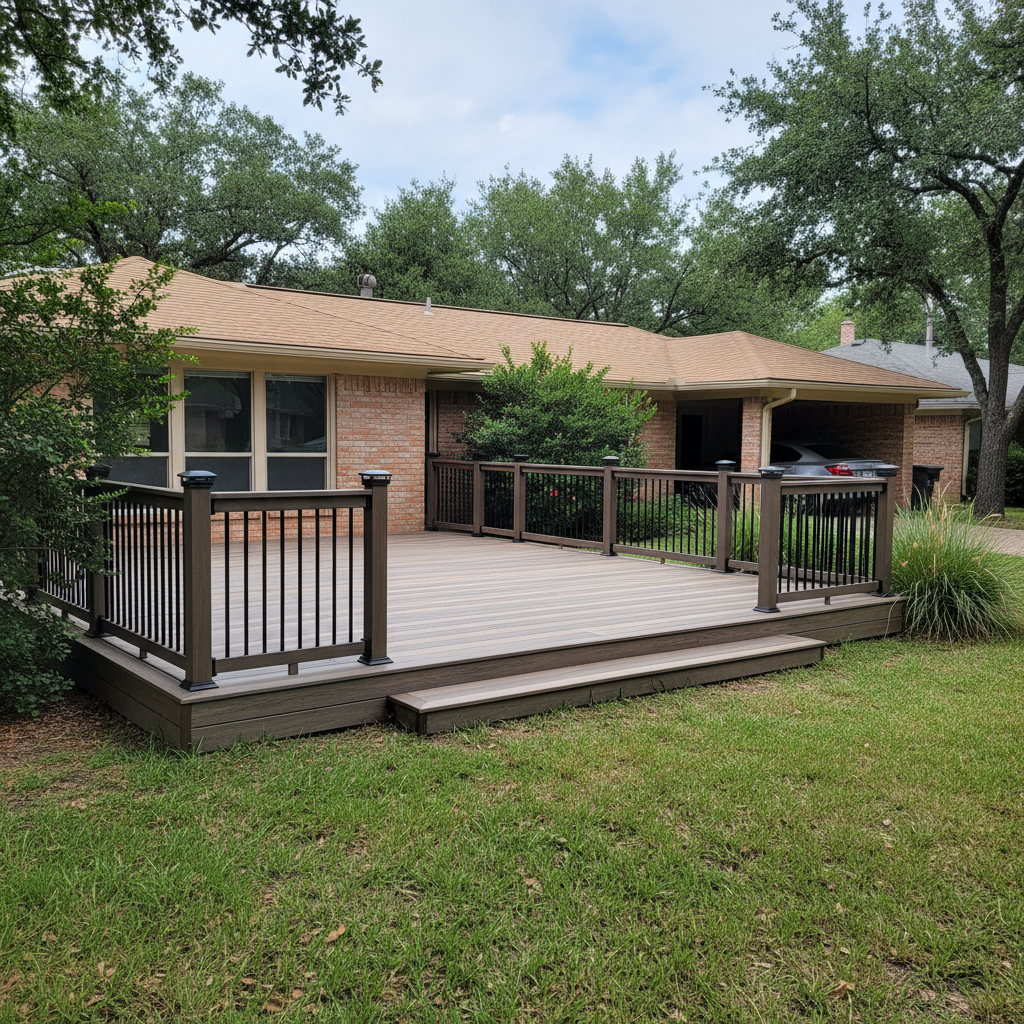
A deck is bolted to your house and sits outside in North Texas weather for the next 15 to 25 years. That's a longer commitment than most home improvements, and it's one most homeowners only make once or twice. So the question of who builds it matters more than the question of what it's built from.
Start with the ground, not the wood
Plano sits on Blackland Prairie clay. That soil swells when it's wet and shrinks hard when it dries, sometimes by a couple of inches over a season. A deck footing that isn't deep enough, or that's just a patio paver stacked under a post, will heave and settle with the clay every year until your railings are out of plumb and your stairs don't line up with the landing anymore.
A builder who knows the area will dig footings down past the active zone of that clay, typically 18 to 24 inches here, and use a bell-shaped or belled pier rather than a straight-sided hole. Ask how deep the footings go and why. If the answer is "however deep the auger goes" or you get a number that sounds borrowed from a different climate, that's worth pushing on.
Permits and HOA approval aren't optional extras
Most attached decks in Plano need a building permit through the city, and the inspector will want to look at the footings before they're poured over and the framing before the decking goes down. A builder who tells you permits aren't necessary for a deck like yours, especially one attached to the house or more than about 30 inches off grade, is either wrong or hoping you won't ask again.
A lot of Plano neighborhoods, Willow Bend, Prestonwood, Shoal Creek and plenty of the newer subdivisions off the tollway, have an HOA with its own rules on setbacks, height, and sometimes even what color stain you can use. Ask your builder if they'll handle the HOA submission or if that's on you. Good ones have done it enough times to know what the architectural committee wants to see on the drawing.
What the house itself tells you
Houses built in Plano before the late 1990s often have a ledger board, the piece that attaches the deck to the house, fastened with nails and no real flashing behind it. Water gets in behind the band board over the years and you don't know it until the rim joist is soft. A builder worth hiring will pull the siding back, look at what's actually there, and flash the ledger properly with a drip edge and membrane, not just caulk the seam and call it done.
Newer construction in subdivisions built since 2000 usually has better flashing to start with, but the framing lumber is often smaller dimension than older homes used, so it changes what the deck can tie into and where it needs its own posts instead of leaning on the house.
Materials, and what our summers do to them
Pressure-treated pine is still the standard for framing and it holds up fine if it's kept dry underneath and off the dirt. For the decking surface itself, you're choosing between wood and composite, and Texas heat is part of that decision. Composite boards get hot to the touch in July and August, sometimes too hot for bare feet by early afternoon, so ask about lighter colors if that matters to your family. Wood decking needs staining and sealing on a schedule, roughly every two to three years here, because the sun bleaches it and the heat dries it out faster than it would in a milder climate. If a builder tells you any wood deck is maintenance-free, they're selling, not informing.
Staining itself has a weather window. You can't put a quality sealer down when the board surface is above about 90 degrees or in direct July sun, it skins over before it soaks in. A builder who schedules staining for early morning or picks a cooler stretch in spring or fall knows what they're doing.
Red flags worth walking away from
- A bid with no mention of footing depth, post spacing, or joist size, just a total price.
- No pull of a permit, or a vague answer about whether one's needed.
- A deposit of more than about a third of the job up front.
- Fasteners not specified. Deck screws and hangers need to be rated for treated lumber, usually hot-dip galvanized or stainless. The wrong fastener corrodes inside the wood within a few years and you won't see it until something fails.
- No answer when you ask how many days before you can walk on new concrete footings, or how long before the deck can be stained after the wood's installed. A new pressure-treated board needs to dry out for several weeks, sometimes a couple of months in our humidity, before stain will actually take.
What a good quote actually looks like
It names the footing depth and type. It names the lumber grade and fastener spec. It says who's pulling the permit and who's dealing with the HOA if there is one. It gives you a rough schedule that accounts for inspection wait times, which can add a few days to a project depending on how busy the city's inspectors are that month. None of that makes for exciting reading, but it's the difference between a deck that's still square in ten years and one that isn't.
We've built and repaired decks all over Plano and the surrounding towns, on the clay lots near downtown and the newer slab foundations further out, and the questions above are the ones we expect homeowners to ask us. If you're comparing bids right now, bring this list with you. You can see more of our deck builder work if you want to know what we actually build before you call.